Where They Stood by Black Community Resource Centre
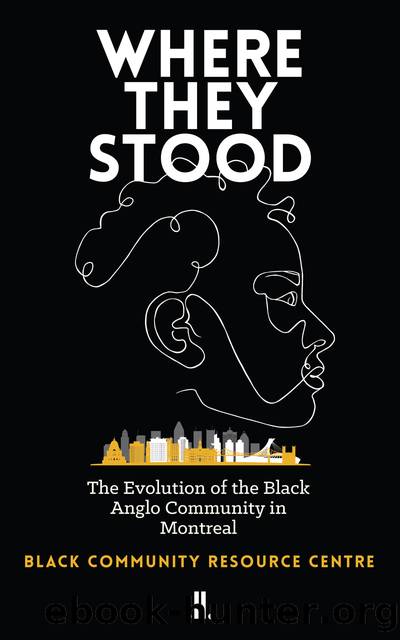
Author:Black Community Resource Centre
Language: eng
Format: epub
ISBN: 9781773901350
Publisher: Linda Leith Publishing
Caribbean Conference Committee
Three years before the creation of the Caribbean Conference Committee (CCC), the failure of the Federation of the West Indies in May 1962 weighed on the minds of many West Indians who were in favour of federalism. For Trinidad and Jamaica, federalism opened doors for independence and a breakaway from colonialism. On the other hand, for smaller Islands, which had not yet attained self-government, it looked promising for âcustom unions and economic development and functional cooperation.â
For many complex reasons, the federation failed, but in August 1962, both Jamaica and Trinidad gained independence from British rule. Many of the other Islands wished to follow in their footsteps. This common aspiration to combat colonialism in the West Indies brought a group of Caribbean men and women together in Montreal. Among this group were Anne Cools, Roosevelt (âRosieâ) Douglas, Franklyn Harvey, Antony Hill, Robert Hill, Alvin Johnson, Hugh OâNeile, and Alfie Roberts. The group was named the Caribbean Conference Committee and was extensively committed not only to the pursuit of West Indian unity but to providing a platform for Black intellectuals to discuss anti-colonial ideas and promote political and social change. The groupâs activities also had the effect of essentially reviving Pan-Caribbeanism. They became engaged in finding solutions to the discrimination and racism that the rapidly increasing Black populations of Canada were facing.
The âTriple Câ worked closely with notable radical West Indian writers such as George Lamming of Barbados, Lloyd Best of Trinidad, and C.L.R. James of Trinidad. James held private classes on Marxism and liberation with the CCC members. Lloyd Best and George Lamming worked with them in the publication of the New World Quarterly, a West-Indian based journal of political economy.
The New World Group met on a regular basis off campus at Levittâs home. The groupâs co-leader, Lloyd Best, emphasized a reconstruction of the existing system based on scholarly research. The New World Group complemented the work of the CCC. For instance, in 1966, New World asked George Lamming to produce a special issue for its journal New World Quarterly on Guyanaâs independence. Lamming, who had ties with the CCC, called on the group to assist in preparing the journal.
New World Quarterly was more than just a journal. It provided young West Indian intellectuals from all different backgroundsâwhether they were historians, poets, literary critics, economists, political scientists, sociologists, or journalistsâa platform. New World Quarterly comprised mostly academics (mainly economists) who were engaged in research on social and economic issues, whereas the CCC was primarily a political organization comprising Caribbean students. Therefore, these groups were not in competition with each other. In fact, the two groups had a similar goal of freeing the Caribbean from colonialism and focused on creating post-colonial Caribbean societies. According to David Austin, Dany Fougères, and Roderick MacLeod, this 1966 prospectus published in New World Quarterly best describes the CCCâs mission:
The purpose of the 1966 Conference will be to discover in ourselves, in our societies, the roots of West Indian freedom. From being the historical agent
Download
This site does not store any files on its server. We only index and link to content provided by other sites. Please contact the content providers to delete copyright contents if any and email us, we'll remove relevant links or contents immediately.
| Anthropology | Archaeology |
| Philosophy | Politics & Government |
| Social Sciences | Sociology |
| Women's Studies |
Cecilia; Or, Memoirs of an Heiress — Volume 1 by Fanny Burney(32562)
The Great Music City by Andrea Baker(32023)
Cecilia; Or, Memoirs of an Heiress — Volume 2 by Fanny Burney(31959)
Cecilia; Or, Memoirs of an Heiress — Volume 3 by Fanny Burney(31945)
We're Going to Need More Wine by Gabrielle Union(19052)
All the Missing Girls by Megan Miranda(16049)
Pimp by Iceberg Slim(14521)
For the Love of Europe by Rick Steves(14163)
Bombshells: Glamour Girls of a Lifetime by Sullivan Steve(14081)
Norse Mythology by Gaiman Neil(13376)
Talking to Strangers by Malcolm Gladwell(13376)
Fifty Shades Freed by E L James(13247)
Mindhunter: Inside the FBI's Elite Serial Crime Unit by John E. Douglas & Mark Olshaker(9347)
Crazy Rich Asians by Kevin Kwan(9297)
The Lost Art of Listening by Michael P. Nichols(7508)
Enlightenment Now: The Case for Reason, Science, Humanism, and Progress by Steven Pinker(7316)
The Four Agreements by Don Miguel Ruiz(6770)
Bad Blood by John Carreyrou(6626)
Weapons of Math Destruction by Cathy O'Neil(6284)
